June 30, 2026 | Tuesday | Pokhara-30, Kaski
Pokhara University has been coordinating an Erasmus+ funded international project MAGENDA – Mainstreaming Gender Equality in Academia (project number 101179725, ERASMUS-EDU-2024-CBHE ) to mainstream gender equality in the selected universities of Nepal and Bangladesh. The 36-month project was started in November 2024 and will be concluded in October 2027. One of the key objectives of the project is the development and implementation of the Gender Equality Plan (GEP) in the six universities, three each from Nepal and Bangladesh. In this context, GEPs have been developed and are being implemented in all six Asian partner universities, including Pokhara University, Far Western University, Kathmandu University, Bangladesh Agricultural University, Sher-e-Bangla Agricultural University, and Bangladesh Open University. The project MAGENDA prioritises integration of all the stakeholders, including university management, teachers, students, admin staff, and community people, to raise gender equality awareness as well as adoption of the GEP.
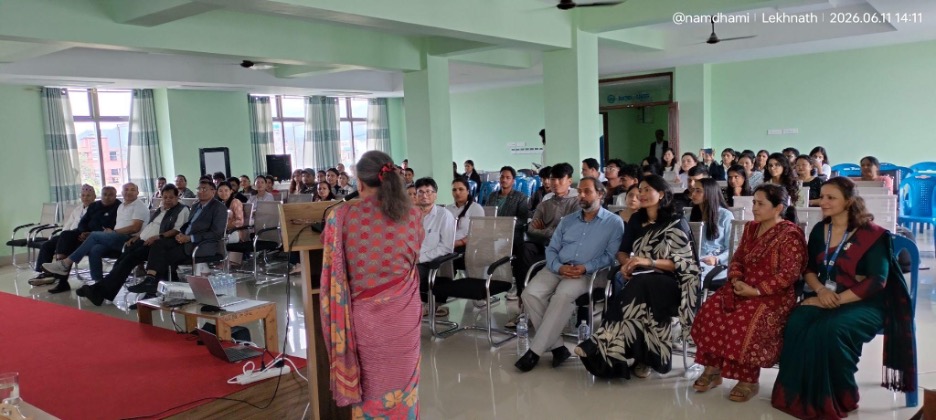
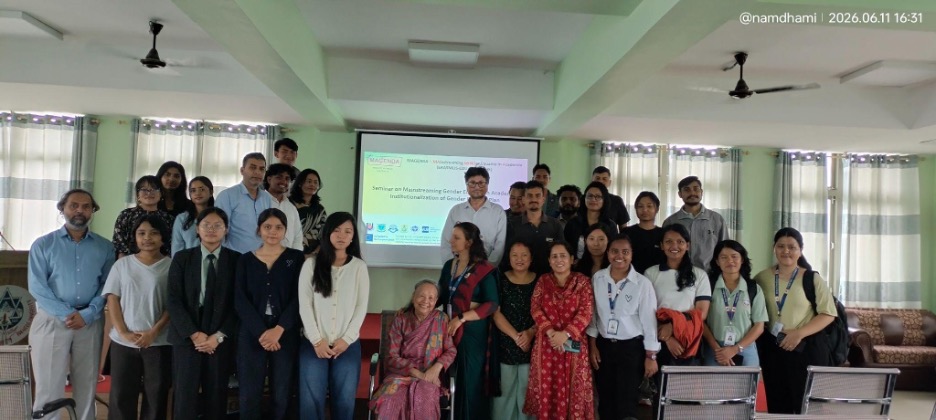
In this context, the MAGENDA project organized a seminar on “Mainstreaming Gender Equality in Academia: Institutionalization of the Gender Equality Plan (GEP)” at Pokhara University on 11 June 2026. The event brought together university officials, administrative staff, faculty members, researchers, and students to discuss the importance of gender equality and its institutionalization in Pokhara University.
The seminar was commenced with the national anthem followed by the project progress presentation of Associate Prof. Dr. Namraj Dhami, International Coordinator of the MAGENDA Project. Dr. Dhami highlighted the mid-term progress of the project alongwith Pokhara University’s role as the coordinating institution and discussed the collaborative framework of MAGENDA involving 10 institutions from four countries – Nepal, Bangladesh, Belgium, and Greece. As of the mid-term progress, the project has completed 12 deliverables as scheduled and 11 deliverables are yet to be completed till the end of the project.
The seminar featured Emeritus Prof. Dr. Chandra Bhadra, an expert in Gender Studies and Gender Equality activist, as a keynote speaker. Prof. Bhadra delivered a talk on “Gender Mainstreaming in Academia: Highlights on Historical Euphoria, Achievements, and Further Agenda.” Witnessing the four decades of dedication, struggle, activism, and lived experience in gender equality and social research, she captivated the audience with uncommon experiences and insights about the challenges and opportunities she passed by as a novice researcher through to a top tier expert in the domain. Prof. Bhadra traced the evolution of gender equality initiatives in Nepal, beginning with the country’s participation in the First World Conference on Women held in Mexico City in 1975. She highlighted the landmark publications including the Status of Women in Nepal by the Centre for Economic Development and Administration (CEDA), Tribhuvan University, in 1979, which laid the foundation for gender-focused discourse and research in Nepal.
Sharing her own academic journey, Prof. Bhadra reflected on her doctoral studies in Family Resource Management at herAlma Mater, the University of Oregon, USA, and her pioneering contributions to institutionalizing gender studies in Nepal. She shared about her decisive inputs to initiate postgraduate studies in Gender Studies at Tribhuvan University in 1996 and integration of gender studies in Grades 11 and 12 curricula under the Higher Secondary Education Board (HSEB) of Nepal. She also highlighted her experience of working as a Gender Expert with various international agencies including SAARC Secretariat and UNIFEM.
Emphasizing the value of participatory and community-based research, Prof. Bhadra stated that her work has always been “research with women, not research on women or about women” highlighting the importance of local wisdom and lived experiences. She also highlighted the higher prevalence of domestic violence among women than workplace violence experienced by many migrant workers. Concluding her address, she encouraged researchers to move beyond exclusive dependence on Western theoretical frameworks, embrace the mindset of lifelong learners, and critically evaluate development paradigms to generate more meaningful and context-sensitive gender research.
The seminar also featured a presentation by Assistant Prof. Dr. Prabati Thapa, a member of the MAGENDA Project team, who shared key learnings from her five-day study visit cum MAGENDA training held at the University of Peloponnese (UoP) in collaboration with KMOP Athens, Greece from 26-30 April 2026. The training was focused on strengthening mechanisms for Gender Equality Plan implementation and monitoring. Major outcomes included enhanced understanding of self-assessment tools, monitoring and evaluation indicators, and effective strategies for GEP implementation.
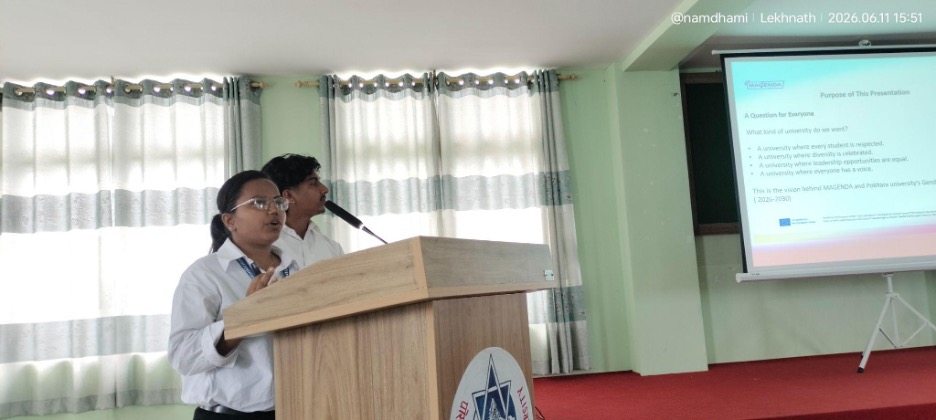
Representing the student community, MAGENDA Student Ambassadors Muskan Keshari (MPharm student) and Surendra Poudel (BALLB student) delivered a talk titled “Gender Mainstreaming in Pokhara University: Students’ Perspective.” They highlighted the roles and responsibilities of student ambassadors in promoting awareness, inclusivity, and gender-sensitive practices within the university community. They concluded their presentation with the powerful message that “Gender equality is not merely a competition between men and women, but a collective fight against injustice.”
Further enriching the programme, Associate Prof. Dr. Rishikesh Pandey presented the implementation strategies and institutional framework of the Gender Equality Plan at Pokhara University. He highlighted the achievements of the MAGENDA project, ongoing initiatives, and future deliverables envisioned under the GEP framework.
The seminar concluded with words of encouragement from Dr. Niranjan Shrestha, Executive Director of Research at Pokhara University, who reaffirmed the university’s commitment to advancing gender equality through the MAGENDA Project. The programme formally came to a close with concluding remarks delivered by the Assistant. Prof. Man Kumari Parajuli. The seminar was attended by more than 140 participants, including teachers, admin staff, students, and representatives from the local government institutions, particularly Pokhara Metropolitan, the District Administration Office, and Nepal Police. The seminar was moderated by Assistant Administrator Sarala Bhatta Bhandari. The event served as a common platform for reflection, dialogue, and collaboration, reaffirming Pokhara University’s commitment to fostering an inclusive academic environment and strengthening institutional efforts toward gender equality and social justice.